Shopping Cart

Complete guide to choosing a professional bakery oven
A professional oven is one of the most important pieces of equipment in a bakery: it directly affects product quality, work speed, and the daily production capacity.
Choosing the right oven means improving not only the baking results but also the efficiency of your workspace and your ability to grow the business. For this reason, there is no absolute "best" oven: the choice depends on the type of product, production volumes, and the specific needs of your facility. Let's look at the main factors to evaluate when choosing the most suitable oven for your bakery.
Which oven to choose based on your bakery's needs
To choose the right professional bread oven, it is best to start with a very simple question: what problem does it need to solve in your workspace?
Here are the most common needs:
- Baking large quantities in a short time
- Managing multiple products with different baking requirements
- Achieving direct baking on the deck (hearth)
- Working continuously for many hours
- Maintaining flexibility with small-scale production
- Optimizing space without limiting processesIn the following sections, we will look at which technology best responds to each need, how it works, and its main advantages and limitations.
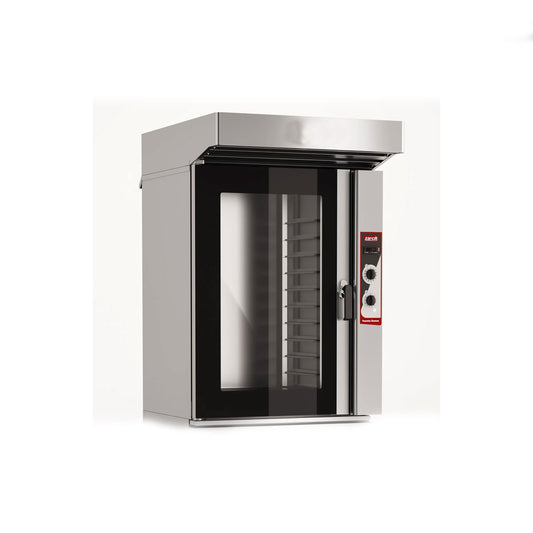
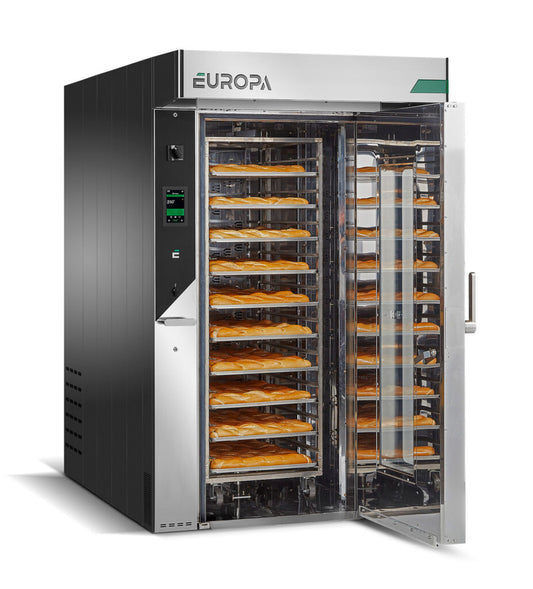
For baking large quantities in a short time: Rotary Oven
The rotary oven is designed for those who need to manage high volumes and numerous batches throughout the day. The rack allows you to load many trays at once, while the rotation ensures even baking.
👍 Ideal if: you want to increase productivity and reduce downtime between cycles.
👎 To consider: requires sufficient space for the oven itself and for maneuvering the racks.
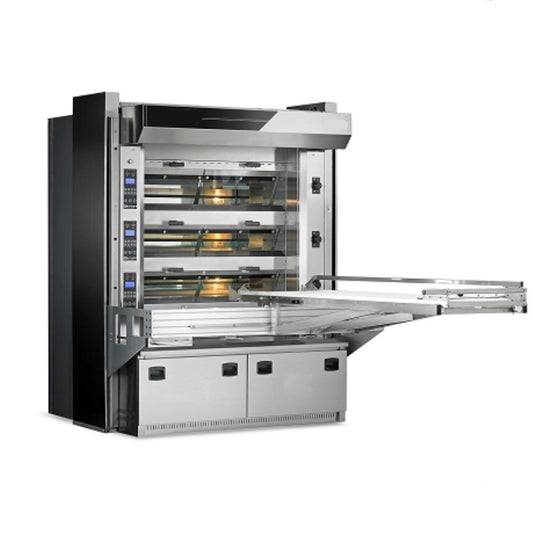
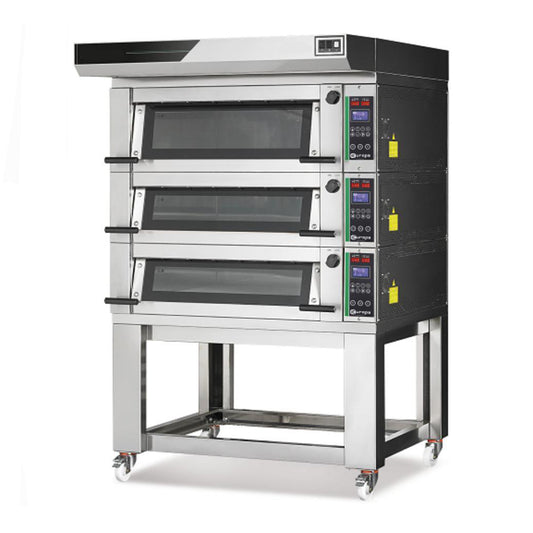
For managing multiple products with different baking requirements: Modular Oven
The modular oven is made up of multiple independent baking chambers that can be used simultaneously with different settings. This allows you, for example, to bake products requiring different temperatures or times at the same moment, giving you greater freedom in organizing production.
👍 Ideal if: you produce many different items throughout the day and need to manage multiple baking cycles simultaneously.
👎 To consider: if you primarily bake large quantities of a single product, you might not fully utilize the flexibility of independent chambers.
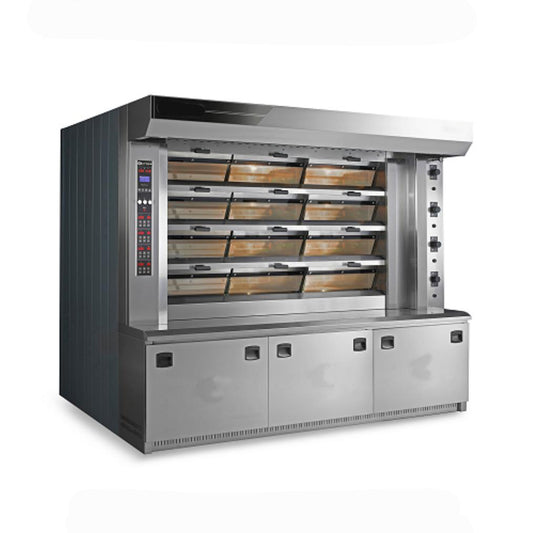
For achieving direct baking on the deck: Deck Oven
The deck oven allows you to bake bread directly on the surface of the baking chamber. It is a particularly appealing technology for artisan bread because it allows for precise heat management and yields a different baking result compared to a convection oven.
👍 Ideal if: deck baking is a crucial part of the final product quality you want to achieve.
👎 To consider: loading and unloading require different organization compared to ovens that operate with racks.
For working continuously for many hours: Annular Tube Oven
The annular tube oven uses a system of tubes that distributes heat around the baking chambers. The main characteristic of this technology is its high thermal inertia: once the working temperature is reached, the oven maintains heat steadily even during many consecutive batches.
👍 Ideal if: the oven runs for many hours and you need continuity and stability in your baking.
👎 To consider: it takes longer to reach the operating temperature and is less suitable for those who need to change temperatures frequently or use the oven for short periods.
For maintaining flexibility with small-scale production: Convection Oven
The convection oven uses internal ventilation that circulates hot air inside the chamber, distributing it across the various trays. It is a compact and versatile solution, particularly practical when producing smaller quantities or alternating different products during the day.
👍 Ideal if: you work primarily with trays, do not need massive capacity, and want an oven that is easy to integrate into your production cycle.
👎 To consider: not the best solution if you are looking for direct deck baking or need to manage very high volumes.
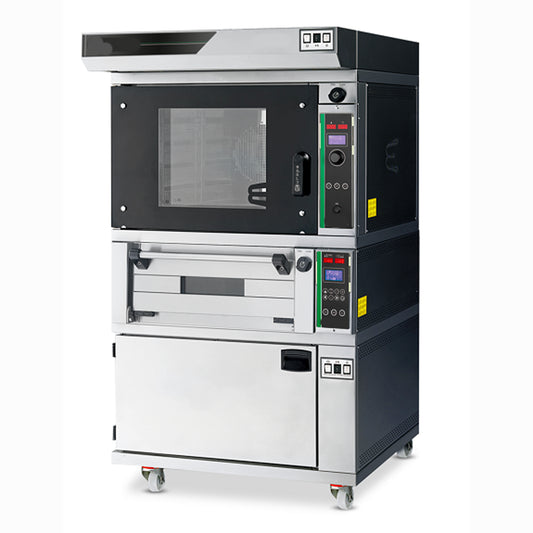
For optimizing space without limiting processes: Combination Oven
The combination oven brings together multiple baking systems and functions in a single structure. It allows you to tackle different processes without having to install separate machines, making it particularly appealing for workshops where every square meter counts.
👍 Ideal if: you are short on space but want to retain the ability to handle different products and baking styles.
👎 To consider: if a single process requires very high volumes, a dedicated oven might offer greater production capacity.
Summary for a quick reference:
- Many trays and high productivity: Rotary oven
- Many different products: Modular oven
- Direct deck/hearth baking: Deck oven
- Continuous production for many hours: Annular tube oven
- Small-scale and versatile production: Convection oven
- Limited space and varied processes: Combination oven
Once you have identified the best technology for your workflow, you can compare different bakery oven models based on capacity, size, power supply, steam management, and energy consumption.
How to choose a bakery oven: electric, gas, or diesel?
After selecting the baking technology, the next step is choosing the power supply. The choice between electric and gas (or, in specific cases, diesel) depends on your facility's setup and operating costs.
- Electric oven: this system offers the greatest installation freedom. It does not generate combustion fumes; you only need to provide an exhaust duct for steam and baking odors (connected outside or to an extraction system). It guarantees precise temperature control and is the standard for modular and convection ovens.
- Gas or diesel ovens: these are considered actual thermal plants and require specific authorizations and stricter compliance. Installing gas ovens requires two separate flues: one for combustion fumes (which must extend past the roof ridge) and one for baking steam. Often, however, for those producing large volumes continuously, gas amortizes the investment by guaranteeing a lower operating cost in the long run.
Energy efficiency: comparing bakery oven consumption
Energy efficiency is another crucial factor to consider, as it directly impacts the bakery's fixed costs. Purchasing a technologically advanced and well-insulated oven guarantees significant energy savings on your bills. Consumption depends heavily on the type and size of the chosen oven. As a general guide:
- Electric ovens (modular or deck): thanks to highly insulating materials, once at temperature, they can consume on average between 4 and 8 kW/h per chamber.
- Rotary ovens (electric): given the large volume of the chamber, power consumption at steady state generally settles between 10 and 50 kW/h.
- Gas ovens (rotary or tube): in this case, the electrical draw is minimal (about 2-4 kW/h to power motors and fans), while the thermal power generated by the burner averages between 40 and 70 kW thermal.
Other technical aspects to consider for your bread oven
Beyond baking technology, there are a few technical aspects that can make a difference in the daily use of the oven:
- Steam management: essential for many types of bread, especially for achieving the correct rise and a well-formed crust.
- Tray and rack sizes: the oven must integrate seamlessly with the equipment already present in your workspace and with your overall workflow.
- Maintenance and cleaning: the accessibility of components and ease of cleaning affect downtime and long-term management.
- Price range: the investment varies based on production capacity. On average, prices range from €3,000 to €15,000 for compact models (convection and small modulars) to €15,000 to €75,000 for large-scale ovens (rotary, deck, tube).
These elements must be evaluated together: an oven that looks perfect on paper can prove impractical if it isn't compatible with your utility systems, available space, or the actual organization of your workshop.
Having the right equipment is the first step to ensuring quality and efficiency, but transforming great bread into a thriving business also requires a solid strategy. Now that you know how to optimize production, discover the tricks of the trade to grow your business: read our guide on how to increase bakery sales.
If you still have doubts about sizing or the most suitable technology, contact us: we can help you find the best configuration for your bakery.